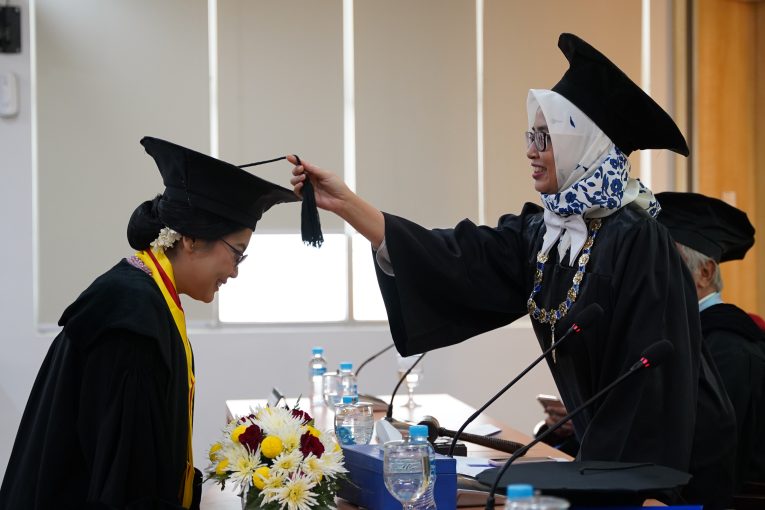
Nevi Kurnia Arianti, S.Psi., M.Si., has officially earned her doctoral degree from the Faculty of Psychology, Universitas Gadjah Mada (UGM), after successfully completing her Open Dissertation Defense in the Doctoral Program in Psychology on Tuesday (January 13) at Room A203, Faculty of Psychology UGM. In the session, she graduated as UGM’s 7,092nd doctoral graduate after defending her dissertation titled “Profiles and Strategies of Community-Based Psychosocial Support for Volunteers in Multi-Hazard Disaster-Prone Areas in Yogyakarta.”
The defense was chaired by the Vice Dean for Academic and Student Affairs of the Faculty of Psychology UGM, Dr. Wenty Marina Minza, M.A. The dissertation was supervised by Prof. Drs. Koentjoro, M.BSc., Ph.D., Psychologist, as Promotor, and Prof. Dr. Muhammad Baiquni, M.A., as Co-Promotor. In her dissertation, Nevi addressed the issue of psychosocial support for volunteers directly involved in disaster response across regions with varying levels of risk in the Special Region of Yogyakarta. She emphasized how community-based approaches play a crucial role in sustaining volunteers’ roles amid the pressures of emergency situations.
“Community-based psychosocial support is essential because volunteers are on the front lines of disaster response and face layered psychological pressures,” Nevi stated during her dissertation defense.
The study employed a qualitative approach by exploring the experiences of volunteers in three disaster-prone areas: Purwosari (Kulon Progo), Girikerto (Sleman), and Girikarto (Gunungkidul). The findings reveal that psychosocial support profiles in each area are contextual and diverse, influenced by the types of disaster threats and local cultural characteristics.
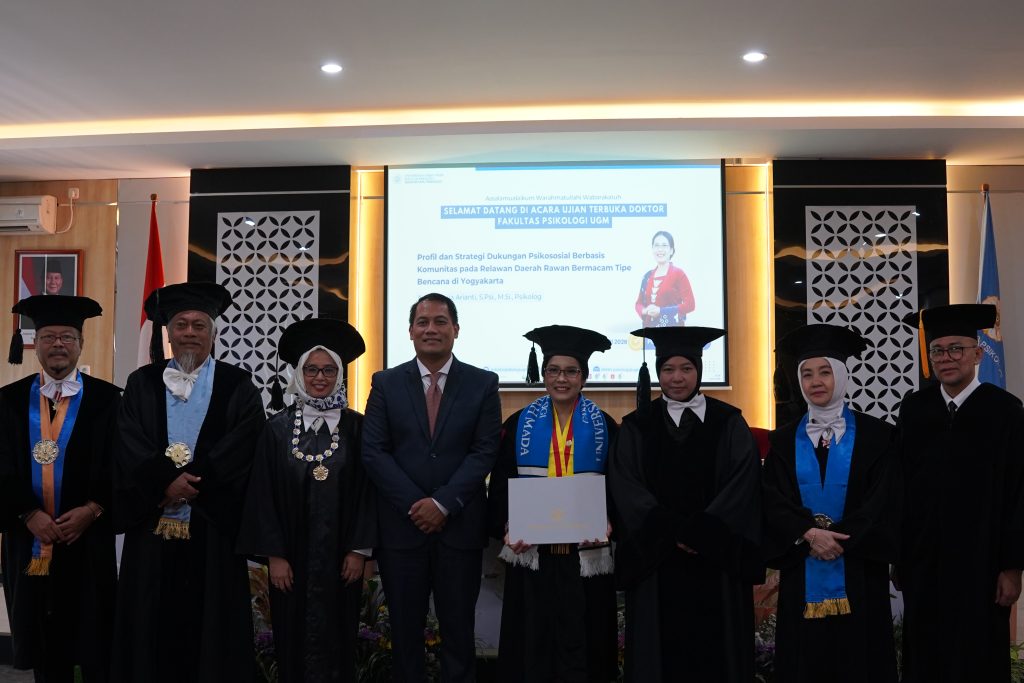
In her presentation, Nevi also highlighted that psychosocial support practices within communities often stem from long-standing local values.
“Community-based psychosocial support is not only related to mental health, but is also rooted in social and cultural values such as mutual cooperation (gotong royong), togetherness (guyub), informal gatherings (jagongan), collective prayers, and local customary practices,” she explained.
Furthermore, Nevi emphasized that psychosocial support strategies cannot be applied uniformly. Differences in disaster types, regional characteristics, and volunteer backgrounds must be considered to ensure that the support provided truly meets field needs.
“Volunteers are not merely field implementers, but also producers of knowledge who contribute to sustaining community resilience and social strength in facing disasters,” she noted.
Nevi hopes that her research can serve as a reference for developing more contextual, community-based policies and programs to support disaster volunteers.
Author: Erna Tri Nofiyana