
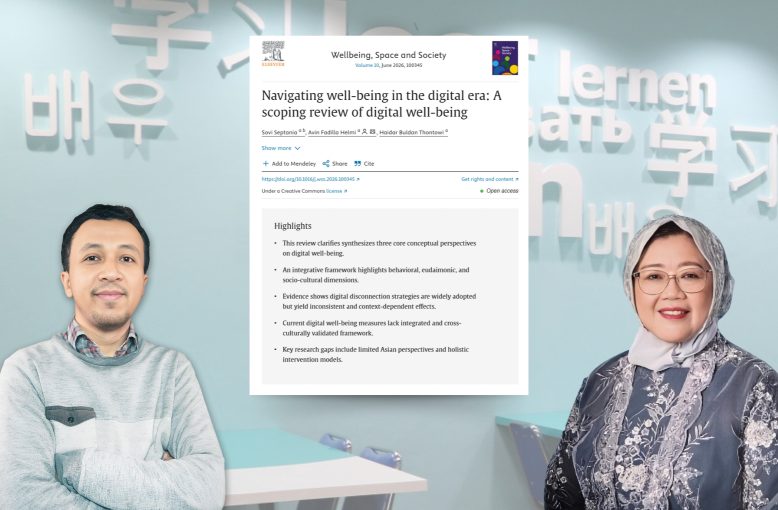
Yogyakarta, 3 February 2026 – The rapid development of digital technology has transformed the way people work, interact, and live their daily lives. Behind the many conveniences it offers, an important question arises: how can well-being be maintained in an increasingly digital world? This question is explored by researchers from the Faculty of Psychology, Universitas Gadjah Mada (UGM), through a comprehensive study on digital well-being. The findings were published in the international journal Wellbeing, Space and Society (Elsevier) in an article entitled “Navigating Well-being in the Digital Era: A Scoping Review of Digital Well-being.” The study was authored by Sovi Septania, Avin Fadilla Helmi, and Haidar Buldan Thontowi.
This research employed a scoping review method, a type of literature review that systematically maps the development of concepts and research findings within a field in a broad manner. Using this approach, the researchers examined a wide range of studies on digital well-being to understand the evolution of concepts, measurements, and interventions related to Digital Well-being (DWB). The results indicate that digital well-being does not have a single, consistent definition and tends to be conceptually overlapping. Existing definitions can be classified into three perspectives: (1) DWB as a well-being concept whose emergence is influenced by technology use; (2) DWB as the perceived impact of digitalization on individual well-being; and (3) DWB as a strategy for balanced technology use. These three perspectives demonstrate that digital well-being is not merely a technological issue, but also involves psychosocial aspects rooted in individual agency and socio-cultural contexts.
The study also identified three main themes that frequently appear in the discourse on digital well-being: (1) intention or motivation in using technology; (2) eudaimonic well-being (meaning-oriented and growth-focused well-being); and (3) socio-cultural context. These themes reflect digital well-being as both an individual and a systemic issue.
In addition, the review highlights the growing trend of digital disconnection, or efforts to limit digital technology use. However, findings from previous studies show that its effectiveness varies, is inconsistent, and is highly dependent on social context. The researchers also found that most existing digital well-being measurement tools are not yet conceptually integrated and have rarely been validated across cultures. This condition points to the need for developing more integrative instruments that are sensitive to socio-cultural differences.
The study further reveals research gaps, particularly the limited perspectives from Asian countries in the global digital well-being discourse. This is notable given that patterns of technology use in Asia have unique characteristics and the region has a very large population of digital technology users.
Through this review, researchers from the Faculty of Psychology UGM propose an integrative framework that can help researchers and policymakers gain a more comprehensive understanding of digital well-being. This framework is expected to serve as a foundation for designing interventions, policies, and educational programs that promote healthy and balanced technology use. The study also reaffirms UGM’s contribution to advancing well-being research in the digital era. Amid rapid technological transformation, understanding digital well-being is becoming increasingly important so that society can benefit from technology without compromising quality of life.
The article is available online at: https://doi.org/10.1016/j.wss.2026.100345
Congratulations to the research team.
Prepared by: Fauzi
Editor: Zufar