
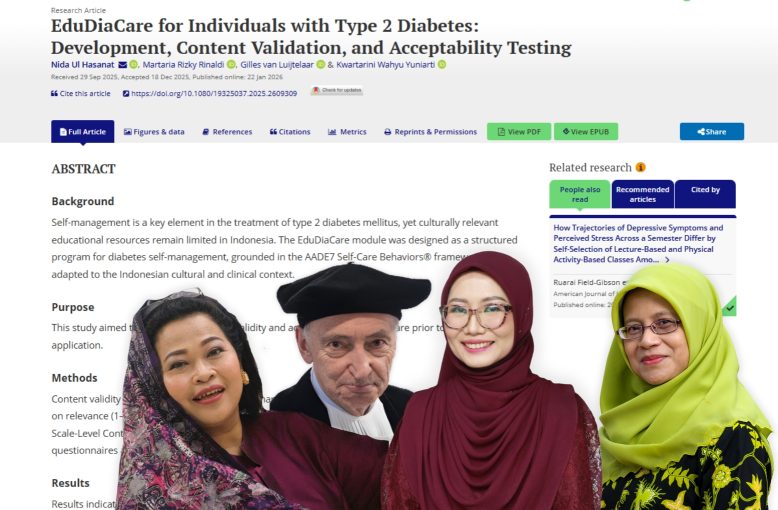
Yogyakarta, 3 February 2026 – Type 2 diabetes mellitus remains a major public health challenge in Indonesia. Beyond medical treatment, the success of diabetes management is strongly influenced by patients’ ability to perform daily self-care. Responding to this need, a research team from the Faculty of Psychology, Universitas Gadjah Mada (UGM), has developed EduDiaCare, a diabetes education module specifically designed to align with the cultural context and living conditions of patients in Indonesia.
This innovation was published in the international journal American Journal of Health Education (2026) through an article entitled “EduDiaCare for Individuals with Type 2 Diabetes: Development, Content Validation, and Acceptability Testing.” The study was conducted by Nida Ul Hasanat, Martaria Rizky Rinaldi, Gilles van Luijtelaar, and Kwartarini Wahyu Yuniarti.
Departing from the limitations of existing educational modules that are difficult to apply practically in Indonesia, the research team designed EduDiaCare as a structured educational module to support patient self-management. The module was developed based on the AADE7 Self-Care Behaviors framework, a systematic conceptual model for diabetes education and intervention. This framework encompasses several behavioral domains that can serve as practical guidelines for effective self-management. What distinguishes EduDiaCare from other modules is its development process, which takes into account cultural values, daily habits, and health practices within Indonesian society. As a result, the materials presented are more closely connected to patients’ everyday lives.
During its development, the module underwent a content validity testing phase involving 10 experts from various disciplines. This validation process evaluated the relevance and practical usefulness of each activity in the module using two measurement tools: the Item-Level Content Validity Index and the Scale-Level Content Validity Index. In addition, the module’s acceptability was tested through open-ended questionnaires administered to five participants after completing the intervention sessions. The results demonstrated a very high level of content validity, with nearly all module components rated as relevant and practically beneficial. Furthermore, acceptability testing indicated that the module is easy to understand, comfortable to use, and applicable in daily life.
Participants also reported that the use of storytelling, a communicative approach, and visual materials in EduDiaCare helped them better understand effective self-management strategies. This approach was considered capable of fostering closer relationships between healthcare providers and patients, thereby making the educational process more effective.
The research team believes that EduDiaCare has strong potential for wider implementation. The module can be utilized by healthcare professionals, counselors, and health educators as a structured, patient-centered guide for diabetes education. In the future, EduDiaCare is expected to contribute to improving self-management abilities among individuals with type 2 diabetes, while also enhancing their quality of life in a sustainable manner. This innovation also reflects UGM’s commitment to delivering research-based health solutions that are relevant to the needs of Indonesian society. Through this study, the Faculty of Psychology UGM once again affirms its role as a higher education institution actively advancing scientific knowledge while generating tangible impacts on public health.
The publication can be accessed at: https://doi.org/10.1080/19325037.2025.2609309
Congratulations to Dr. Nida Ul Hasanat, Prof. Kwartarini, and the team of authors.
Prepared by: Fauzi
Editor: Zufar