
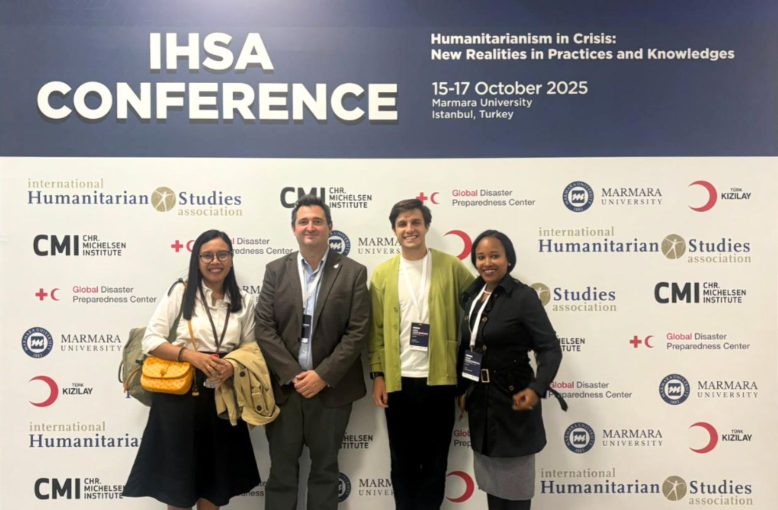
Caption (English): From left to right: Dr. Pradytia, Omar Abou-Samra (Senior Director, GDPC), Vladislav Kavaleuski (Research and Knowledge Management Program Manager, GDPC), and Dr. Tirsit (GDPC grantee in Addis Ababa).
Pradytia Putri Pertiwi, S.Psi., Ph.D, a lecturer at the Faculty of Psychology, Universitas Gadjah Mada (UGM), was invited by the American Red Cross through the Global Disaster Preparedness Center (GDPC) to present her research on the inclusivity and actionability of volcanic hazard Early Warning Systems (EWS) for persons with disabilities in Indonesia. The study has been published on the GDPC–American Red Cross platform under the title “Inclusivity and actionability of volcanic hazard Early Warning System in Indonesia: Perspectives of persons with disabilities”.
This research was presented at the International Humanitarian Studies Association (IHSA) Conference 2025, held on 15–17 October at Marmara University (Istanbul) and the Chr. Michelsen Institute/CMI (Bergen), under the theme “Humanitarianism in Crisis: New Realities in Practices and Knowledges.” In Istanbul, Pradytia spoke on the panel “Getting Ahead of Disasters by Connecting Early Warning and Anticipatory Action That Works for All,” organized by the Risk-informed Early Action Partnership (REAP) and GDPC. Through her paper, “Perspectives and experiences of persons with disabilities on the inclusivity of volcanic hazard Early Warning System in Indonesia,”
Pradytia discussed how persons with disabilities access and act upon early warning information during disasters. The field study was conducted in two villages around Mount Merapi and involved 182 persons with disabilities and organizations of persons with disabilities (OPDs) through surveys, focus group discussions, as well as thematic and spatial analyses. Key findings indicate the coexistence of traditional and modern warning systems; however, persons with disabilities continue to face gaps in accessibility, coverage, and message clarity. The study underscores the strategic role of OPDs in integrating EWS into community preparedness, fostering long-term risk reduction behaviors, and strengthening anticipatory action.
In addition, Dr. Pradytia presented “Mental Health and Psychosocial Support for Refugee with Disabilities: A Scoping Review” in the roundtable “Diversity, Equity and Inclusion in Humanitarian Action: Anyone Still Interested?” chaired by Prof. Dennis Dijkzeul (Ruhr University Bochum), a research partner of the UGM Faculty of Psychology. This paper was co-authored with Arifa Widyasari, S.Psi., M.Psi., Psychologist. This scoping review maps the forms and implementation of psychosocial support for refugees with disabilities globally, identifying 34 selected articles from 12,049 publications between 2001 and 2024, with most studies originating from Europe and the Middle East. The findings show that psychosocial support most commonly takes the form of inclusive basic services (e.g., health and education) and specialist interventions (psychotherapy and trauma-focused care). However, community-level and non-specialist services remain underdeveloped, despite their potential to enhance accessibility and cultural relevance.
Pradytia’s participation in IHSA 2025 highlights the commitment of the UGM Faculty of Psychology to advancing evidence-based, inclusive, and equitable humanitarian policy and practice. Through field research and global synthesis, these contributions demonstrate that early warning systems and psychosocial support co-designed with communities, underpinned by strong accessibility standards, and integrated with social networks and technological tools are prerequisites to ensuring that no one is left behind in disaster governance amid an increasingly complex crisis landscape.
Disclaimer:
The “Inclusivity and actionability of volcanic hazard Early Warning System in Indonesia: Perspectives of persons with disabilities” research project was funded by the UK government managed by GDPC. The views expressed do not necessarily reflect the UK government’s official policies
Writer: Raden Roro Anisa Anggi Dinda