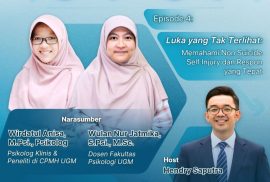
The Faculty of Psychology at Universitas Gadjah Mada (UGM), in collaboration with TVRI Yogyakarta, presents the fourth episode of OPSI: Psychological Talk, which aired on Tuesday, May 20, 2025, from 3:00 to 4:00 PM WIB. This episode addresses an important and sensitive topic titled "The Invisible Wounds: Understanding Non-Suicidal Self-Injury and Appropriate Responses."
SDG 17: Partnerships for the Goals
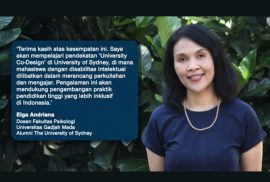
The Faculty of Psychology, Universitas Gadjah Mada, has once again received positive news from the international grant arena. Elga Andriana, S.Psi., M.Ed., Ph.D one of the faculty members, has been selected as a recipient of the Australian Alumni Grant 2025. This grant is a prestigious recognition awarded to Australian alumni who are considered to have significant potential to contribute to the development of education, collaboration, and community empowerment.
Yogyakarta — The Human Resources Development Unit (UPKM) of the Faculty of Psychology, Universitas Gadjah Mada (UGM) has once again been trusted as the implementing partner for the Potential and Competency Assessment for employees of the Ministry of Transportation (Kemenhub). In this period, the assessment is aimed at employees within the Directorate General of Land Transportation (DJPD). This activity is part of the strategic collaboration that has been established routinely for the past few years between UPKM and Kemenhub in an effort to support the strengthening of the quality of human resources (HR) in the transportation sector.
The Faculty of Psychology at Universitas Gadjah Mada (UGM) and TVRI Yogyakarta return with the latest episode of OPSI: Psychological Talk. The third episode aired on Tuesday, May 6, 2025, from 3:00 to 4:00 PM WIB, featuring the theme "Thriving Schools as the Foundation of a Golden Generation: Pillars of the Nation’s Future."
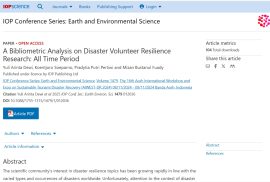
Yogyakarta, May 5, 2025 — A recent study titled “A bibliometric analysis on disaster volunteer resilience research: All time period”, published in the Scopus-indexed proceedings IOP Conference Series: Earth and Environmental Science 1479 012036, reveals global trends, collaborations, and key focuses in disaster volunteer resilience research.
The Faculty of Psychology, Universitas Gadjah Mada, through its Center for Public Mental Health (CPMH) team, has once again received international recognition with the successful awarding of funding for the proposal “Religion and Healing: Collaborative and Participatory Methodologies (RHEAL)” from the Horizon Europe Framework under the Marie Skłodowska-Curie Actions (MSCA) Staff Exchanges scheme. The RHEAL program focuses on developing cross-cultural and interdisciplinary approaches to healing in the field of mental health.
The Faculty of Psychology at Universitas Gadjah Mada (UGM) and TVRI Yogyakarta once again present OPSI: Psychological Talk, a weekly interactive talk show. The second episode aired on Tuesday, April 29, 2025, from 3:00 to 4:00 PM WIB, featuring the theme "Click, Borrow, Regret: Understanding Online Loans through Neuroscience."
The Faculty of Psychology at Universitas Gadjah Mada (UGM), in collaboration with TVRI Yogyakarta, presents a weekly interactive talk show titled OPSI: Psychological Talk. The premiere episode aired on Tuesday, April 15, 2025, from 3:00 to 4:00 PM WIB, featuring the theme "Unveiling the Phenomenon of Brain Rot."
The Center for Public Mental Health (CPMH) at the Faculty of Psychology, Universitas Gadjah Mada, once again demonstrated its commitment to improving mental health and disability literacy among adolescents through the organization of the Adolescent Mental Stability Advocate Competition (AMSAC) Vol. 2. Carrying the theme “Breaking Barriers, Opening Opportunities: Realizing a Generation that Cares about Mental Health and Disabilities,” this year’s AMSAC series took place from April 10 to May 25, 2025, with the main event held at Joglo GIK UGM.
AMSAC Vol. 2 was designed as a platform for junior and senior high school students from across Indonesia to express their concern and ideas on mental health and disability issues. Through various creative competitions such as essay writing, digital poster design, reels, and short story contests, participants were encouraged to highlight the role of youth in building inclusive environments, fostering appreciation for mental health warriors, and breaking down the negative stigma that still exists in society. All submissions were collected online from April 20 to May 4, 2025, and the enthusiasm was evident with around 200 participants taking part.
The program focused on drafting manuscripts from prior research titled “Culture and Morality: A Comparison of Moral Endorsements and the Formation of Moral Intentions in Australia and Indonesia.” In addition, plans for collaborative research were developed with universities and institutions across various countries, including Australia, Malaysia, Hong Kong, the United States, and Europe. This research aims to map moral judgments and moral endorsements among adults in different cultures, representing both Western and Eastern perspectives. Understanding the endorsement of moral values is crucial for comprehending societal differences regarding what is considered right and wrong. For example, some societies view LGBT issues as merely variations and not something inherently bad, while others strongly oppose LGBT and seek its eradication from society. Such differences are expected to become increasingly diverse and intense in the future, necessitating anticipatory measures to prevent conflicts that could disrupt societal harmony at both national and global levels.
This research is expected to provide insights into the shifting moral values in society over time. Understanding these changes is particularly important for analyzing societal transformation patterns, especially among adults. Moving forward, the research design will be expanded to include adolescents and children in Indonesia to fully comprehend the developmental patterns of moral values in the country. This knowledge will make a meaningful contribution to efforts aimed at enhancing socio-cultural resilience.
Furthermore, through planned research collaborations, the publication of future research findings is expected to have a positive impact on a broader audience, fostering partnerships among various stakeholders and strengthening the institution’s position both nationally and globally. As such, this program supports the achievement of SDG No. 16 (“Peace, Justice, and Strong Institutions”) and SDG No. 17 (“Partnerships for the Goals”).